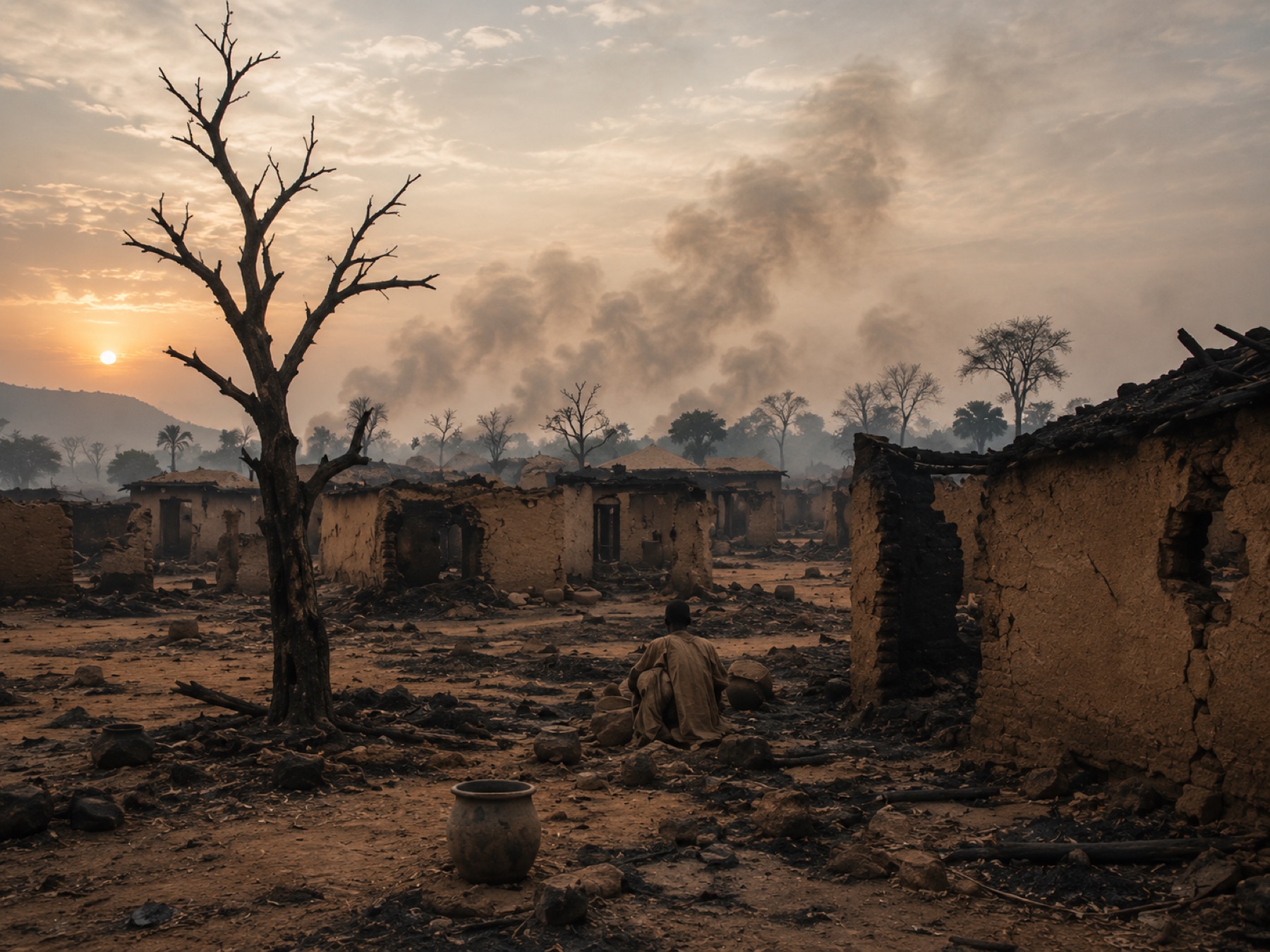
A burned village at dusk in Nigeria's Middle Belt.

Discover · The issues

Four fronts. One crisis.

Terrorism, religious persecution, and a humanitarian collapse in Nigeria, with consequences that reach far past its borders.

01

Terrorism

Since 2014, Fulani militants, a small, armed faction within the wider Fulani population, have escalated attacks on predominantly Christian communities, striking with sophisticated weapons and near-total impunity.

In the northeast, Boko Haram operates largely among the Kanuri people. Having pledged allegiance to ISIS, it now often calls itself the Islamic State of West Africa.

2014
Year Fulani militant attacks began accelerating sharply
02

Religious freedom

Northern Nigeria is often portrayed as uniformly Muslim. In reality, Christians make up at least 30% of the region's population, and far more in some areas.

For 15 to 20 years, these communities have faced escalating discrimination and targeted persecution, largely absent from the global narrative.

30%+
Christian share of Northern Nigeria's population, in some areas far higher
03

Humanitarian crisis

Boko Haram's campaign has driven hundreds of thousands from their homes, scattering families across Nigeria and into neighbouring countries.

Displaced communities face acute barriers to food, clean water, shelter, and other basic rights, a crisis still deepening today.

100Ks
Nigerians displaced by Boko Haram attacks in the north
04

Beyond Nigeria's borders

This crisis doesn't stop at a border. More than 300,000 displaced Nigerians have fled into Cameroon, Chad, and Niger, nations already strained by food insecurity and their own terror threats.

Nigeria is also a strategic U.S. partner and one of the world's most populous nations. Its destabilisation is a security concern for the region, and for the West.

300K+
Displaced Nigerians now sheltering in Cameroon, Chad, and Niger
Source: UNHCR

The solution

US policy can help. Here's how.